

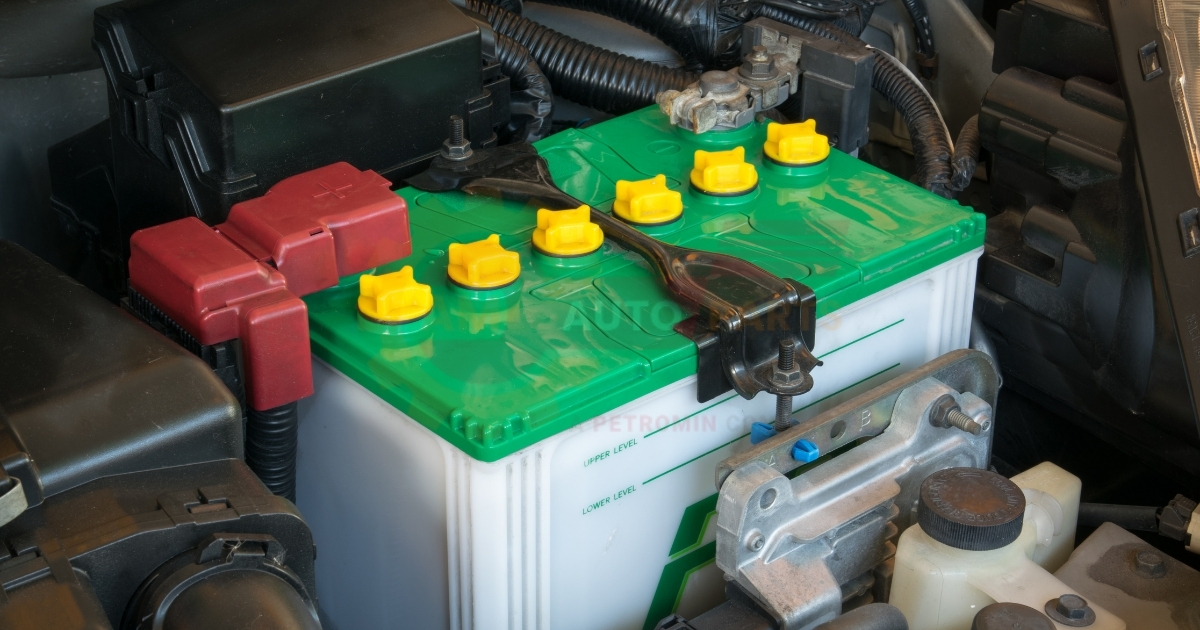
A healthy, fully charged car battery should read between 12.4V and 12.7V after sitting overnight. If it drops below 12.2V, it may need recharging or replacement, especially in hot climates like the UAE.
A car battery that sits overnight gives you the most honest reading of its true health. No surface charge, no engine influence, just the raw state of the battery. So what number should you actually see on your multimeter in the morning?
This guide breaks it all down in plain terms.
What Is the Normal Car Battery Voltage After Sitting Overnight?
A healthy, fully charged 12-volt lead-acid battery should read between 12.6V and 12.8V after sitting overnight. This resting state is called the open-circuit voltage (OCV), and it reflects the battery’s true state of charge (SOC) without any load or charging influence.
Here is a quick reference table:
| Voltage Reading | State of Charge | Battery Condition |
| 12.6V – 12.8V | 100% | Fully charged, healthy |
| 12.4V – 12.5V | 75–85% | Acceptable, monitor it |
| 12.2V – 12.3V | 50% | Weak, needs charging |
| 12.0V – 12.1V | 25% | Poor, charge immediately |
| Below 12.0V | Under 25% | Critical, may need replacement |
| Below 11.8V | Near dead | Likely damaged or sulfated |
Most modern vehicles use a 12V flooded lead-acid, AGM (Absorbent Glass Mat), or EFB (Enhanced Flooded Battery). AGM batteries often sit slightly higher, around 12.8V to 13.0V when fully charged, so keep your battery type in mind when reading these numbers.
Why Overnight Resting Voltage Is the Most Accurate Battery Reading
Testing right after you drive is misleading. The alternator charges the battery while the engine runs, which leaves a temporary surface charge on the battery plates. This can push the voltage reading up to 13.2V or higher, making a weak battery look perfectly healthy.
After the car sits for 8 to 12 hours, that surface charge naturally dissipates. What remains is the true resting voltage, which tells you:
- The actual electrolyte concentration in each cell
- Whether the battery is holding a proper charge
- If there is internal degradation or cell imbalance
This is why most professional technicians and battery manufacturers recommend testing only after an overnight rest. It removes all variables and gives you a clean, stable baseline reading.
Think of it like checking your blood pressure after resting; any activity before the test skews the result.
How Temperature Affects Car Battery Voltage Overnight
Temperature has a direct impact on battery voltage and performance. Lead-acid batteries are electrochemical devices, so the ambient temperature changes how the electrolyte reacts inside the cells.
Cold temperatures slow down the chemical reactions inside the battery. This causes the voltage to read slightly lower than it actually is, and it also reduces the battery’s cold cranking amps (CCA), meaning it has less power to start the engine.
Hot temperatures speed up internal chemical activity, which can cause slightly higher voltage readings. However, heat accelerates degradation, water loss, and plate corrosion of the battery in Dubai over time.
Here is how temperature affects a fully charged battery’s expected voltage:
| Temperature | Expected Resting Voltage |
| 80°F (27°C) and above | 12.6V – 12.8V |
| 60°F (15°C) | 12.5V – 12.7V |
| 40°F (4°C) | 12.4V – 12.6V |
| 20°F (-7°C) | 12.2V – 12.5V |
| 0°F (-18°C) | 12.0V – 12.3V |
Practical tip: If you test your battery on a cold morning and get a reading of 12.3V, the battery may not necessarily be weak. Factor in the temperature before concluding. If the reading stays low even after the weather warms up, that is a real concern.
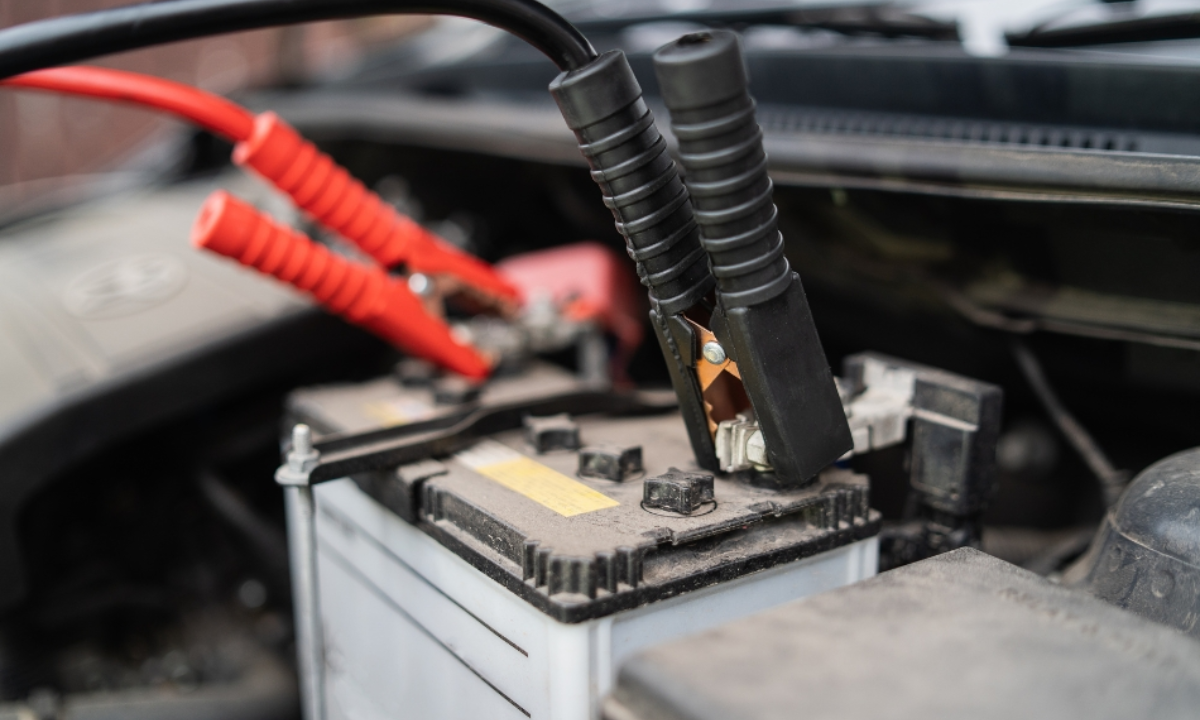
How to Correctly Measure Your Car Battery Voltage at Home
You do not need a professional shop to test battery voltage. A basic digital multimeter is enough, and the process takes less than two minutes.
What You Need:
- Digital multimeter (set to DC voltage, 20V range)
- Safety gloves (optional but recommended)
Step-By-Step Process:
- Park the car and turn everything off: Leave it sitting for at least 8 hours, ideally overnight.
- Open the hood and locate the battery: Identify the positive terminal (red, marked +) and negative terminal (black, marked –).
- Set your multimeter to DC voltage, select the 20V DC setting.
- Connect the red probe to the positive terminal and the black probe to the negative terminal.
- Read the voltage on the display: Note the number.
- Compare your reading to the voltage chart above.
Things To Avoid During Testing:
- Do not test immediately after driving
- Do not test with accessories running (headlights, radio, AC)
- Do not test in extremely cold conditions without factoring in temperature correction
- Make sure the probes are making solid contact with the terminals
If your multimeter reads below 12.4V after an overnight rest, charge the battery fully and retest. If it still reads low, the battery likely has a deeper issue like sulfation, dead cells, or internal short circuits.
Choosing the Right Battery Matters Too
Testing voltage is only one part of the equation. If your battery consistently shows weak readings, it may not be the right fit for your vehicle or climate.
Before replacing your battery, it’s worth understanding how to pick the right one based on your driving needs and environment.
Read this guide: How To Choose The Best Battery For Your Car?
Is Your Car Battery Draining Overnight? How to Find the Cause
If your battery reads significantly lower every morning, or the car struggles to start after sitting overnight, there is likely a parasitic drain or a battery health issue at play.
Common Causes Of Overnight Battery Drain:
- Parasitic draw: A component draws power when the car is off (faulty relay, stuck module, bad wiring)
- Aging battery: Batteries older than 3–5 years lose their ability to hold a charge
- Faulty alternator: If the alternator is not charging the battery properly during driving, it will be low by morning
- Extreme cold: Cold reduces battery capacity and can make a marginal battery fail overnight
- Leaving accessories on: Leaving accessories on: Lights, phone chargers, or dash cams left plugged in can slowly drain the battery. *Note: Interior electronics like dome lights or infotainment systems are common culprits. For a breakdown of these components, see our guide on car interior parts names.
Aging battery: Batteries older than 3–5 years lose their ability to hold a charge. In hot regions like the UAE, choosing a high-quality replacement becomes even more important. You can explore reliable options like High-quality Powertech Batteries in Dubai, UAE designed for extreme temperatures.
How To Check For Parasitic Draw:
- Turn off the car and remove the key
- Set your multimeter to DC amperage (milliamps setting)
- Connect it in series between the negative battery terminal and the negative cable
- A healthy car should draw less than 50 milliamps after all systems go to sleep (usually 10–20 minutes)
- If the draw is above 100 milliamps, there is an abnormal parasitic drain
You can then pull fuses one by one to isolate which circuit is causing the excessive draw.
How Long Should You Charge a Car Battery Before Testing Voltage Again?
If your battery is tested low, you need to fully recharge it before testing again. Testing an undercharged battery gives a false reading and can lead you to replace a battery that was simply discharged.
Charging Time Depends On The Charger Type And Battery State:
| Charger Type | Charge Rate | Estimated Time for Full Charge |
| Trickle charger | 1–2 amps | 12–24 hours |
| Standard home charger | 4–8 amps | 4–8 hours |
| Fast charger | 10–15 amps | 1–3 hours |
| Smart charger (automatic) | Varies | Auto-detects and stops |
Recommended Approach:
- Use a smart charger or trickle charger for the most accurate charge without overcharging
- After charging, let the battery rest for at least 2 hours before testing, ideally overnight
- This rest period allows the surface charge to dissipate, so the voltage reading is stable and accurate
Avoid fast charging unless it is an emergency. Rapid charging can cause heat buildup and plate damage, especially in older or already weakened batteries.
Using the Right Battery Brand Improves Charging Efficiency
Not all batteries respond the same way to charging. Premium battery brands are designed to handle repeated charge cycles more efficiently and maintain stable voltage levels.
For example, Top-rated POWEREX Automotive Batteries in Dubai, UAE are built for durability and consistent performance, especially in demanding conditions.
Common Mistakes People Make When Testing Car Battery Voltage
Even with the right tools, small errors can lead to wrong conclusions. Here are the most frequent mistakes and how to avoid them:
- Testing right after driving: The alternator leaves a surface charge on the battery. This inflates the voltage reading. Always wait at least 8 hours.
- Not accounting for temperature: Cold weather drops voltage. A reading of 12.3V at 20°F may be normal for the temperature, but would be concerning at 80°F.
- Using a cheap or uncalibrated meter: An inaccurate multimeter gives unreliable readings. Use a decent-quality digital meter for consistent results.
- Testing with loads still active: Even a small interior light or a plugged-in USB charger pulls voltage down during the test. Make sure everything is off.
- Confusing a discharged battery with a dead battery; A battery at 11.9V may just be deeply discharged, not dead. Charge it fully and retest before replacing it.
- Not cleaning corroded terminals before testing: Heavy corrosion on the terminals creates resistance that can slightly lower the reading. Clean the terminals with a wire brush before testing.
- Ignoring the battery age: A battery reading 12.5V at 6 years old should still raise a flag. Voltage alone does not tell the full story; a load test is also worth doing on older batteries.
Avoiding these mistakes takes less than five minutes of preparation but can save you from misreading a healthy battery as dead, or worse, trusting a failing one.
When It’s Time to Replace Your Battery
If your battery keeps dropping voltage overnight even after proper charging, replacement is the best solution. Choosing a battery that matches your vehicle and climate ensures longer life and fewer breakdowns.
You can also check High-Performance Atonic Batteries in Dubai, UAE if you’re looking for reliable performance and long-term value.
Final Thoughts
After sitting overnight, a healthy car battery should read between 12.6V and 12.8V. Anything below 12.4V deserves attention. Anything below 12.0V is a warning that the battery is either deeply discharged or failing.
Overnight resting voltage is the single most reliable home test you can do, more accurate than a quick surface charge reading and far cheaper than a shop visit. Combine it with a temperature adjustment and a parasitic draw check if needed, and you have a solid picture of your battery’s true condition.
If the battery keeps dropping overnight despite a full charge, it is time to consider a replacement, especially if it is more than 4 years old.
FAQs
What Voltage Is Too Low For A Car Battery After Sitting Overnight?
Any reading below 12.0V after an overnight rest is considered critically low. The battery is either deeply discharged, sulfated, or has a dead cell. Charge it first and retest. If it still reads below 12.0V, replacement is likely needed.
Is 12.4v Okay For A Car Battery?
It is acceptable but not ideal. A reading of 12.4V means the battery is around 75% charged. It may still start the car, but it should be charged and monitored, especially in cold weather.
Can A Battery Read 12.6v And Still Be Bad?
Yes. Voltage alone does not tell the full story. A battery with a damaged cell or sulfation may read 12.6V at rest but fail under load. A load test or conductance test at an auto parts store gives a more complete picture.
How Do I Know If My Car Battery Is Draining Overnight?
If the voltage drops more than 0.2V overnight without any loads connected, something is drawing current when it should not. Check for parasitic draw using a multimeter set to milliamps.
Does A New Car Battery Need Charging Before Use?
Most new batteries are shipped at around 70–80% charge. It is a good idea to give them a full charge before installation or at least drive for an extended period to let the alternator top them up.
What Is The Difference Between Resting Voltage And Charging Voltage?
Resting voltage is measured with the engine off and no charge source connected; it reflects the battery’s stored energy. Charging voltage is measured while the engine runs and typically ranges from 13.8V to 14.7V, which is the alternator output maintaining the battery.