

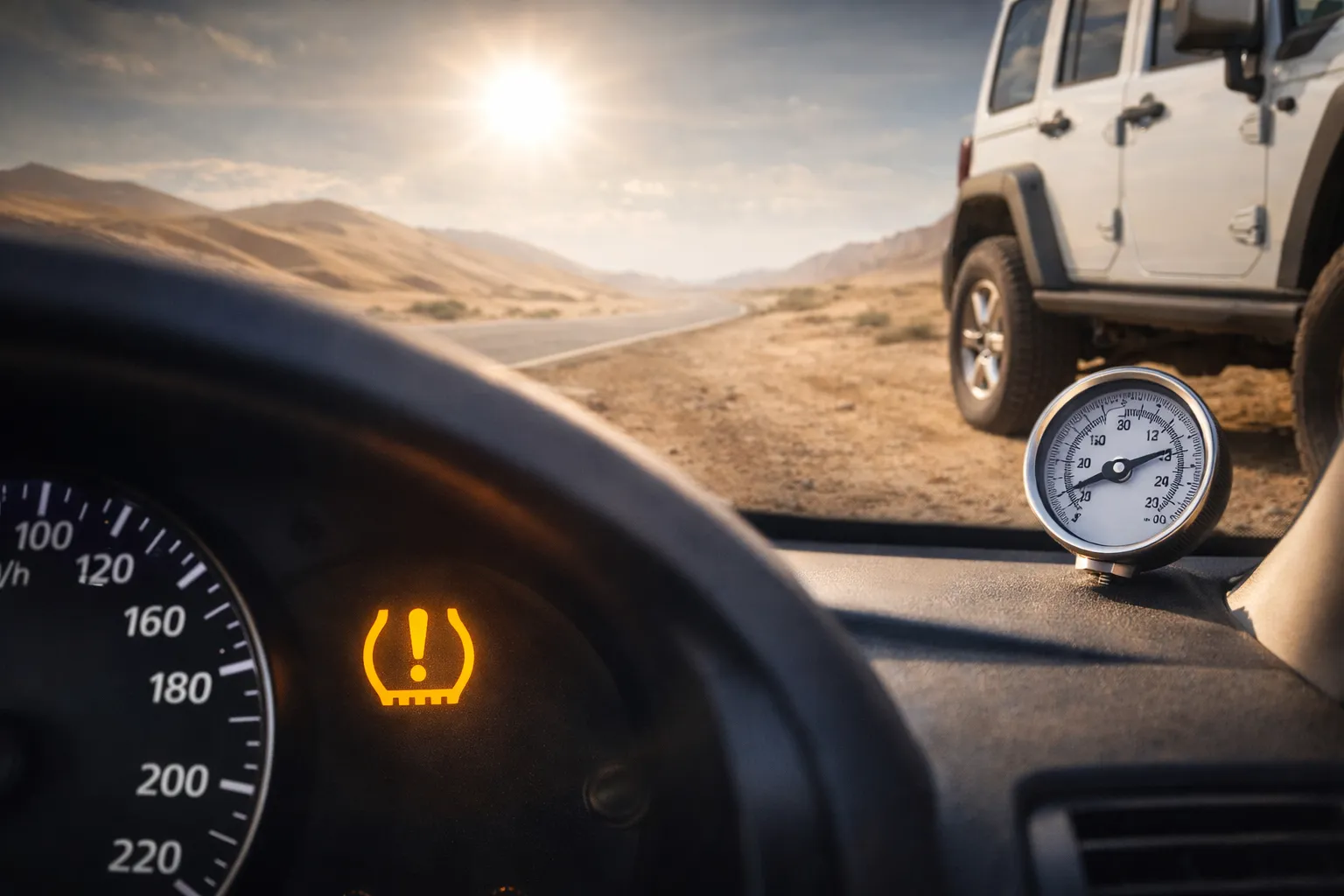
Your tyre pressure warning light just lit up — but every tyre looks fine. This is one of the most common and confusing situations UAE drivers face daily, and it rarely means what you fear.
The truth is: the TPMS (Tire Pressure Monitoring System) is an extremely sensitive electronic system that reacts to small pressure changes — many of which are caused by UAE’s extreme heat cycles, not by actual tyre damage. Understanding what the TPMS system is and how it works is the first step to responding correctly instead of panicking.
This guide gives you a clear, UAE-specific breakdown of every reason this happens, how to diagnose it, and exactly what to do — step by step.
Quick Answer: Most Likely Causes for UAE Drivers
- Overnight temperature drop — air contracted and crossed below the TPMS threshold
- TPMS system is not reset after the last tyre inflation or rotation
- One tyre is 5–7 PSI low — not visible without a gauge
- Tires inflated while hot — false reading, dropped when cooled
- TPMS sensor battery weakening after 5+ years of UAE heat
- Spare tyre underinflated — many UAE SUVs include it in the TPMS loop
1. What Does the Tire Pressure Warning Light Actually Mean?
The low tyre pressure light — that horseshoe-shaped dashboard symbol with an exclamation mark — is not a puncture alarm. It is a pressure alert. It activates when one or more tyres drop to 25% below the manufacturer’s recommended PSI, or when the monitoring system detects an inconsistency.
Alongside the TPMS light, your dashboard may show other alerts. Understanding all your car dashboard warning lights helps you prioritise what needs attention now versus what can wait.
In UAE conditions, the TPMS light often triggers even with visually normal tyres because: (a) small pressure drops happen rapidly due to temperature swings, and (b) many UAE vehicles are imported with sensors calibrated for cooler climates.
KEY POINT: The TPMS light responds to pressure readings — not to physical tyre damage. A tyre can look perfectly normal and still be below the safe threshold.
2. Why This Happens More Often in the UAE
UAE road surface temperatures exceed 60°C in summer. Tires inflated correctly at noon can lose 2–3 PSI overnight as temperatures drop — enough to trigger the TPMS threshold by the next morning. This cycle repeats daily in coastal cities and more severely in inland areas like Al Ain and the Northern Emirates.
Long high-speed drives on Sheikh Zayed Road or the Abu Dhabi–Dubai highway build significant heat inside tyres. After parking, rapid cooling causes pressure to drop below the threshold — triggering the warning the next time you start the car.
Additionally, many UAE vehicles are imported from the US, Europe, or Japan, where TPMS calibration suits cooler, more stable climates. These sensors activate more frequently in the UAE’s variable temperature environment — not because something is wrong, but because the threshold was set for a different climate.
3. The 10 Real Reasons Your Tire Pressure Light Is On (Tires Look Fine)
Reason 1: Overnight Temperature Drop — Most Common in the UAE
This is the single most common cause in the UAE. Air contracts when cooled. A tyre inflated correctly at 35°C can drop 2–3 PSI by early morning at 15°C — triggering the TPMS. Once you drive and the tyres warm up, pressure may rise back above threshold, but the light stays on until the system is reset.
Fix: Check pressure in the morning, inflate to the cold PSI recommendation, and drive briefly. The light should reset automatically or can be cleared manually.
Reason 2: TPMS System Not Reset After Tire Service
After inflating, rotating, or replacing tyres, many vehicles require a manual TPMS reset. Without it, the system holds old data and keeps showing the warning even when the current pressure is correct.
Fix: Perform a manual TPMS reset (see Section 5). Always request this at the workshop after any tyre service.
Reason 3: One Tire Is Slightly Underinflated — Not Visible
A tyre that is 5–7 PSI below the recommended level looks visually normal. TPMS sensors catch exactly this — the invisible pressure loss that starts affecting fuel efficiency and handling before you can see it. This is also when tyres lose air silently through a missing or damaged valve cap — worth checking before assuming a sensor problem.
Fix: Use a digital gauge on every tyre individually. Don’t skip the spare.
Reason 4: Tire Pressure Checked While Tires Were Hot
Inflating tyres immediately after driving gives an artificially high reading. When tyres cool to ambient temperature, pressure drops — often below the TPMS threshold. This is extremely common at UAE petrol stations, where drivers inflate right after arriving.
Fix: Always inflate when tyres have been stationary for 3+ hours (cold tyres).
Reason 5: Abnormal Tire Wear Affecting Pressure Distribution
Uneven or cupped tyre wear can affect how pressure distributes across the tyre contact patch. Understanding the common causes of outside tyre wear can help identify whether a structural wear problem is compounding your TPMS issue.
Fix: Inspect tread wear pattern across all four tyres. Replace worn tyres before they create a safety risk.
Reason 6: TPMS Sensor Battery Weakening
TPMS sensors are battery-powered and typically last 5–7 years. UAE heat accelerates battery degradation significantly. A weakening battery sends inconsistent signals — causing the warning light to appear randomly even when tyre pressure is correct.
Fix: If your vehicle is 5+ years old and the TPMS light keeps returning after resets, have sensor batteries tested.
Reason 7: After Tire Rotation — TPMS Needs Relearn
After rotation, the TPMS ECU may not correctly identify which sensor is at which wheel position. Without a TPMS relearn procedure, the system may show incorrect readings or keep the warning light on.
Always ask your workshop to perform a TPMS relearn after every rotation. Check our guides on when to rotate car tyres in Dubai and the FWD tyre rotation guide to stay on schedule.
Reason 8: Spare Tire Is Underinflated
Many UAE SUVs and 4x4s include the spare tyre in the TPMS monitoring loop. A spare that hasn’t been inflated in months can trigger the warning even when all four main tyres are correct. Most full-size spares should be kept at 60 PSI.
Reason 9: TPMS Sensor Damaged by Heat or Sand
Desert driving, sandstorms, and extreme heat can physically damage TPMS sensors over time. Minor corrosion or debris intrusion causes inaccurate readings and repeated false alerts — especially in off-road vehicles.
Reason 10: TPMS System or ECU Fault
In rare cases, the TPMS computer module has an internal fault. This is most common in older vehicles and usually produces a flashing light (not solid). An OBD-II diagnostic scan can confirm this.
4. Quick Diagnosis Table
| Cause | Visual Tires? | Risk | Fix |
| Overnight temp drop | Normal | Low | Inflate cold + reset |
| TPMS not reset | Normal | Low | Manual TPMS reset |
| Slightly low pressure | Normal | Medium | Check gauge, inflate |
| Hot inflation mistake | Normal | Medium | Re-inflate cold |
| Weak sensor battery | Normal | Medium | Replace sensor |
| Spare tire low | Normal | Low | Inflate the spare to 60 PSI |
| Post-rotation issue | Normal | Low | TPMS relearn |
| Sensor damage | Normal | Medium-High | Replace sensor |
| ECU/system fault | Normal | High | OBD-II diagnostic |
5. How to Reset the Tire Pressure Light — Step by Step
First, inflate all tyres to the cold PSI shown on your door jamb sticker. Then reset using one of these methods:
- Dashboard Menu Method: Settings → Vehicle Info → Tire Pressure → Reset (works on Toyota, Nissan, Hyundai, Kia)
- Reset Button Method: Engine OFF, ignition ON. Hold the TPMS reset button (under the steering column) until the light blinks 3×. Start the engine, drive 10 min.
- Drive Reset: Drive at 60+ km/h for 10 minutes. System auto-confirms stable readings and resets.
If the light returns within 24 hours, this is not a reset issue — check sensor health or refer to Section 3 causes.
6. Is It Safe to Drive with the TPMS Light On?
If you have confirmed correct pressure with a gauge:
- Short distance (under 20 km): generally safe while investigating
- Highway speed driving: not recommended until the cause is confirmed
- Ignoring the light for 24+ hours: not advised in UAE heat conditions
For long UAE road trips, run-flat tyres vs standard tyres is worth reading — run-flat tyres provide a safety window if you do experience real pressure loss while driving on remote roads.
7. When to Visit a Professional Workshop
- TPMS light returns within 24 hours of resetting
- Light flashes (instead of staying solid) — indicates a sensor or system fault
- Vehicle is 5+ years old without a sensor check
- Pressure readings vary inconsistently between daily checks
- You’ve had a tyre rotation without TPMS relearn
AM Autoparts UAE supplies genuine OEM-compatible TPMS sensors for Toyota, Nissan, BMW, Mercedes, Kia, Hyundai, and more. Call +971 52 107 2627 or visit am-autoparts.ae.
8. Preventive Tips for UAE Drivers
- Check tyre pressure once a month — always cold (before driving)
- Keep a digital gauge in your car — petrol station gauges are often inaccurate
- Inflate to the door-jamb PSI — not the number printed on the tyre sidewall
- Always request TPMS relearn after tyre rotation or replacement
- Check the spare tyre pressure every 3 months
- In summer: inflate early morning before ambient heat builds
For quality tyres in Dubai UAE that handle the UAE’s extreme conditions, AM Autoparts stocks leading brands suited to GCC climate requirements.
Frequently Asked Questions
Q: Can heat alone turn on the TPMS light in UAE?
Yes. This is the most common cause in the UAE. A temperature change of 10°C shifts tyre pressure by 1–2 PSI — enough to cross the TPMS threshold. It is the system working correctly, not malfunctioning.
Q: Should I ignore the warning if the tyres look fine?
No. Always verify with a pressure gauge. Tires can be 5–7 PSI low and look visually normal. If the gauge confirms correct pressure, then reset the TPMS and monitor.
Q: How long do TPMS sensors last in UAE conditions?
Typically 4–7 years under UAE heat (versus 7–10 years in cooler climates). If your vehicle is approaching this age with repeated false alerts, replacement is likely needed.
Q: Does tyre rotation affect TPMS?
Yes. After rotation, the TPMS requires a relearn procedure to map the new sensor positions. Without it, the system displays incorrect or persistent warnings.
Q: What PSI should I inflate tyres to in the UAE summer?
Always inflate to the cold PSI shown on your driver’s door jamb sticker. Do not add extra pressure ‘for the heat’ — the TPMS and tyre construction account for thermal expansion within safe limits.
Final Thoughts
If your low tyre pressure light is on but your tyres look fine, you are not facing a crisis — you are seeing a very common UAE driving experience. In most cases, the cause is a temperature shift, a skipped reset, or a slightly low tire that looks normal to the eye.
Take the systematic approach: check pressure with a reliable gauge, inflate if needed, perform a TPMS reset, and monitor. If the light persists, sensor inspection is your next step.
For genuine TPMS sensors and UAE-tested tyres, visit AM Autoparts UAE at am-autoparts.ae or call +971 52 107 2627.
Related Post:
When To Rotate Your Car Tyres In Dubai: A Complete Guide
Fwd Tire Rotation: An In-Depth Guide